Mapping the Three Mills Loop

The weekend before last we went on an organised walk and talk called Three Mills Loop around Bow in East London. It was organised by Gordon Joly, who is someone I meet up with at wiki gatherings. He’s a prolific photographer of random bits and bobs around London, as indicated by his flickr photostream which literally streams a constant flow of new photos appearing on my ‘friends photos’ display. But while he was guiding us and talking about some of the sites on the walk, I thought I’d out-photo him on this occasion. I took 274 photos around the route! They were mostly exceedingly uninteresting though, because I was actually doing some photo mapping, so it was pictures of street signs, pubs, post boxes and other mappable things. In the openstreetmap software I can lay out the photos along my GPS trace.
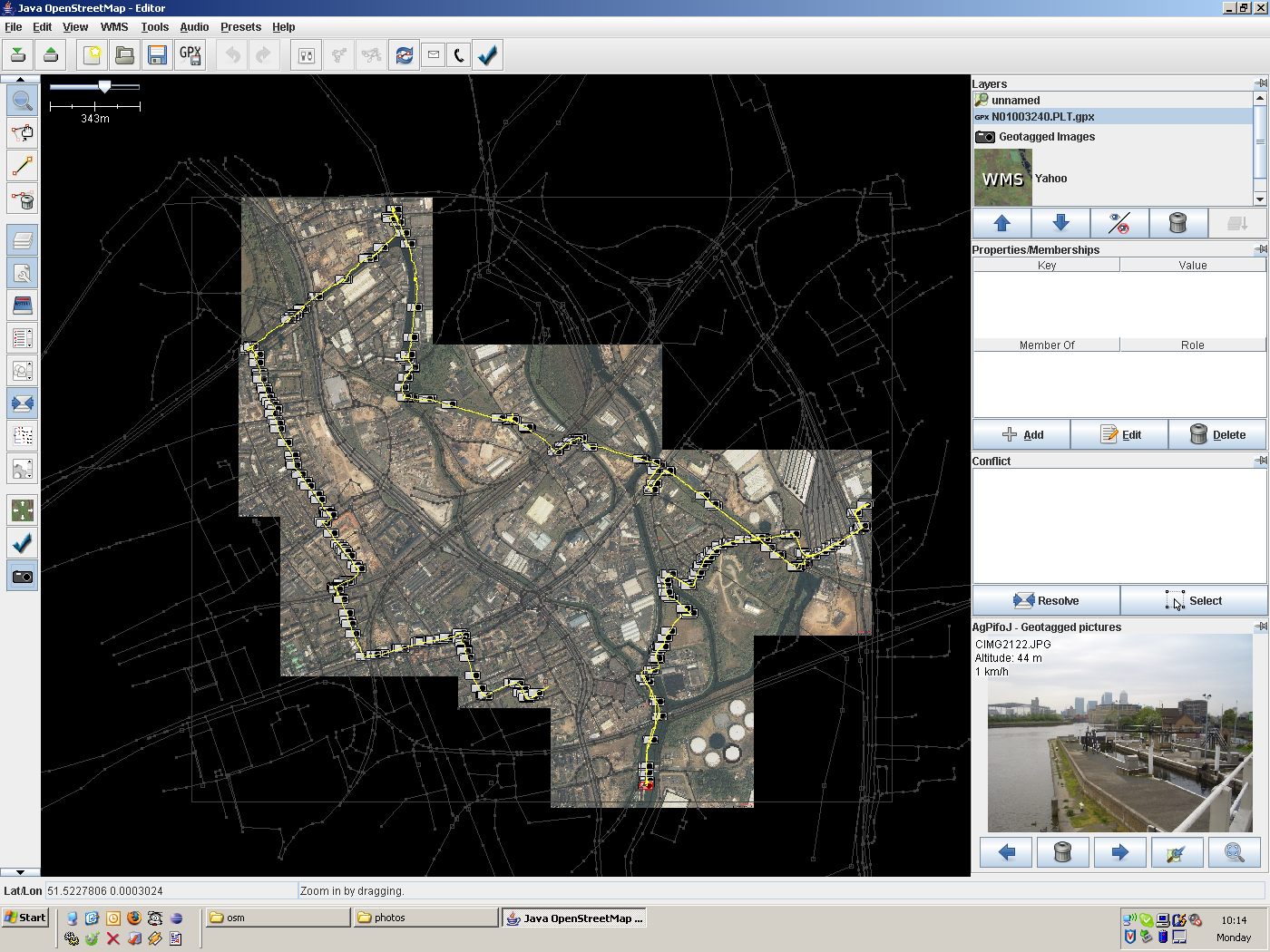
Three Mills Loop photos in JOSM
click to enlarge

That’s what it looks like alongside the nodes and ways of the openstreetmap data (shown here as a deselected layer in faint grey). The openstreetmap data can be modified in this JOSM software. I was able to develop the coverage, adding new street names etc which were missing from the map before. My contributions now appear on the map of the area

A recently added feature of openstreetmap is the ‘Export’ tab, which allows export to SVG format. This means you can play around with a vector representation of a map, with full power and flexibility to craft your own image. I tried this for creating map images for wikipedia articles. This walk presented another opportunity to give this a try. Here’s a map illustrating the route of the Three Mills Loop walk:

Three Mills Loop Map

This map image isn’t just a yellow line overlaid on top of an OpenStreetMap image. I’ve customised the map graphic (using inkscape) to tidy it up. I corrected some of the rendering quirks, including moving some street names, removing extraneous one-way arrows and A/B road markers. I’ve also made the area around Bromley-by-Bow station much clearer, including pedestrian underpasses, to make it easier to find the House Mill meeting place:
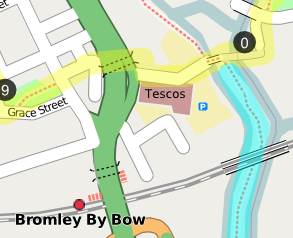
House Mill Access

This has been made possible by the recently added ‘Export’ tab feature of OpenStreetMap. Try doing that with google maps!

The walk route took us past some pleasant canal scenery, and we passed right through the Olympic construction zone. It turned out that the extents of this needed to be updated on the map (although it no doubt still needs some further corrections). This was an interesting sight to see, as was the old Victorian Abbey Mills pumping station.
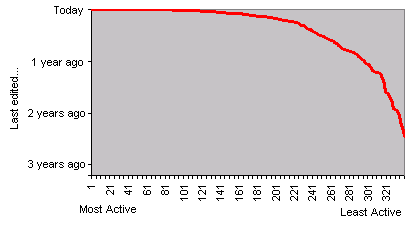
London’s most active wikipedia editors.

There are 341 wikipedia users who have added themselves to Category:Wikipedians in London. I wanted to know which of these people had been active recently. My guess was that a small minority of these people were actually still around in the wikipedia community.

I wrote a little bot in java which harvested the information. I needed the date of their most recent wiki edit. Ranking the users by this metric, it turns out I was wrong. About half of these people have edited this month (pretty recently), and the vast majority have made edits within the last year. I guess people who go to the trouble of adding a ‘Living in London’ userbox, tend to be quite dedicated, and likely to stick around in the community.

Active London Wikipedians           

My plan was to send direct messages to the active users, to make sure they know about the next London Wikipedia Meetup. My original idea was to whittle down the list, to eliminate what I thought would be the large majority of inactive users. But this hasn’t helped me whittle down the list at all! It’s a more helpful ranking than an alphabetical list though:

London wikipedians ranked by most recent edit

Fun to play with developing bots too.

Trafalgar Square Hawk

Trafalgar Square Hawk
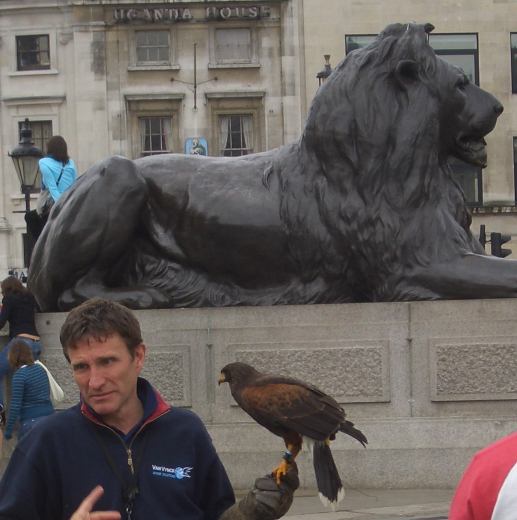
On Sunday we went on a walk through several parks, but at our start point, before we even got to any parks, we had another interesting ornithological encounter. In amongst the usual tourist crowds I noticed a big brown bird of prey swooping onto a perching spot in one corner. The hawk then flew past my head back to his owner, a guy standing by Nelson’s column. I hadn’t noticed until then, but there were no pigeons. Not a single one!

I must have missed the news, that the authorities have deployed this hawk as a pest control technique. Awesome. It’s amazing how effective it seems to be. We saw one or two pigeons flying very high up, and veering away from the square. Apart from that, nothing.

I notice the idea has its critics, and the enevitable save the pigeons campaign group. They call it “bloodsport”. I didn’t see any blood, because there were no pigeons! They’re obviously all scared shitless of it. Interestingly that website also claims that pigeons do not pose a disease problem. I think they’re probably right about that. How many people d’you hear about catching diseases from pigeons? But I’m not a fan of pigeons. There’s too many of them. They crap everywhere, and they’re just boring.

Hawks on the other hand…. kick ass!

Pharmaceutical wrinkles

I generally dislike pharmaceutical companies, especially cosmetics companies. I could pretend that I have strong ethical, ecological, political rational reasoning behind this. There’s so much to dislike about them. But really I just instinctively dislike them. In a chemist I find the air choking with all the smelly overpriced beauty products. I grab my 55p litre bottle of apple flavoured shampoo and get out as quickly as possible.

But right now I’m particularly thinking about the TV adverts. Cosmetic TV adverts are certainly among the worst kind (well the worst kind generally allowed on british TV, which thankfully has some fairly strict vetting) Do they think we don’t notice the ludicrously bad lip-synching? L’Oreal have always advertised a lot on TV. Their latest ad has that woman from four weddings and funeral, talking about wrinkles. She says:

“…I call them my life story lines”

Why?? No you don’t! Nobody has a special name for their wrinkles! Shut up!

8th London Wikipedia Meetup

We went for a sunday lunch pub meet up with some wikipedia enthusiasts last Sunday. It took us a while to get this organised (and I even ended up doing a bit of the organising) but eventually the turn out was pretty good.

In the pub we had a few others like me, but actually most were wikipedia sysops and some were even more “powerful” within the chaotic organisation of wikipedia. I’m an enthusiastic wikipedia contributor, or at least I’m enthusiastic about what wikipedia represents. I am fascinated by wiki technology, and the processes that it facilitates within wikipedia (the most extreme example of a wiki).  I would say I have a deep understanding of this, but actually as far contributing goes, I only dip in and edit articles briefly when I spot somewhere I can make a quick improvement.

I met James F. who is on the wikipedia arbitration committee, and Theresa knott who used to be, and WJBscribe who is current chair of the mediation committee. What this basically means is, these people dedicate a lot of time and energy into keeping wikipedia going. These are the people who essentially have the “final say” with a calming voice of reason, when disputes turn nasty. I have a lot of admiration for them, but I wouldn’t want to take on the task myself.

What do I mean by “disputes”? Wikipedia encourages good will among contributors, as it opens up every article to public editing. Anyone can edit anything, and provided people act in good faith, that might be the end of the matter; the encyclopaedia just gets built… bit-by-bit, collaboratively. Remarkably this actually works a lot of the time. Unfortunately this is not always a harmonious collaboration. You may have to engage in a discussion to persuade others not to revert your edit. Where there is discussion, there may be debate, which leads to arguments, which lead to furious rows. Still, the people involved in such a row are allowed to edit the articles. To prevent the disputes raging out of control across the community, there are hierarchies and layers of permissions, and processes for “mediation” and ultimately “arbitration”. The people on the mediation and arbitration committee must regularly deal with people who will argue their cases politely (otherwise they would just be blocked), but who are simmering with anger and vitriol.

Seth Finkelstein’s critical description of wikipedia as an “elaborate hierarchical structure which is infested with cliques and factional conflicts” isn’t so inaccurate, but what does he expect? It’s an open community of volunteer editors in which the voices of sanity and calm need to somehow triumph when debates erupt. Perhaps he could suggest a better way of organising it (Instead he seems to be deeply concerned about the state of Jimmy Wales’ ex-girlfriend’s biography article). The mediation and arbitration committee have a kind of a position of power at the top of some hierarchy, but it looks like hard emotionally draining work. Clearly they are an essential part of what allows wikipedia to keep running smoothly. I am grateful that some people have the energy to do it.

Anyway… Those guys obviously enjoyed the opportunity to meet up face-to-face, chatting enthusiastically about organisational voting processes, and other such topics which went way over my head. The rest of us had some more down-to-earth chit-chat about general topics of interests. I briefly showed people some OpenStreetMap stuff before laptop battery died. This was all good fun. Hopefully we can arrange another London meet-up pretty soon.

Unit Testing SOA and Mule talks

I’ve attended another couple of free talks this week:

Frank Cohen: The Next Step in Unit Testing and Java & SOA

Frank Cohen spoke about his company PushToTest and the open source “Test Maker” product, but despite being a bit of product plug, it was interesting and entertaining. He spoke about the rising tide of awareness around unit testing, and explained his company’s approach of providing consulting services around this free open source product. He’s clearly taken on the challenge of competing on an open playing field, which reminded me of the business ideas of wikinomics.

Of course the talk was supposed to be about unit testing in general, and he did talk about various other open source testing tools, which was educational for me, since I’m coming from a world of very expensive “enterprise” proprietory software. I do think that GH Tester holds its own against pushtotest and open source offerings, but it also appeals to an entirely different client base; enterprise customers who are willing to shell out for a supported “product” and a unified interface with drag-n-drop goodness. It was clear from the talks and demos, that there’s lots of open source test tools out there, but most still require you to get your hands dirty with raw coding of scripts / xml configurations, and while being “domain specific” is an advantage, using multiple tools is always a pain. Having to get to grips with two or three different tools with different gui/config faff, is a hassle GH Tester avoids.

Nonetheless I learned a lot, and enjoyed Frank’s friendly presentation style. In fact I found him very approacheable, and wound up chatting with him for hours at the pub afterwards.

Antoine Borg, Mule: SOA or IRL?

I originally thought the title of this talk sounded more interesting than Monday’s, but obviously not many other people agreed. When I turned up, there was only two other people there! I actually attended a talk about mule before, back in the days when EJUG talks were still running, so this served as a refresher. I’m trying to think how GH Tester could hook into this ESB. Connect to a mule broker? or perhaps suck in the mule config, and generate transports from the endpoint definitions?

Retro Blogging

Home Technology ClockI’m planning to flesh out my embryonic blog a little, by importing some blog posts from the past, or bits of writing which could be blog posts but originally were not. I guess I’ll set the posting timestamp to a false value indicating approximately when I originally wrote it. This will mean they disappear into the archives, which is right, because it’s stuff I wrote a long time ago, but it’s wrong because nobody will know what I’ve most recently added to the site. So I guess I’ll add some links to this blog post, to reference the new old stuff.

It’s also very tempting to set false timestamps on posts when I’m catching up on events from a few weeks back. Is that cheating? Making it look like I wrote a blog post on the day I got back from my weekend away, rather being slow and disorganised and posting several weeks later? Maybe yes. I guess I will refrain from doing this.

Another thing I could do, is write brand new blog posts about previous things that have happened to me many months or years ago. It seems like there’s some interesting memories which should have been blogged, and would have been if I had just got on with it sooner But I could get quite carried away with this type of Retro-blogging . Trying to catalogue all the key events of my life to form a complete time line (lifelogging?), and basically writing a lot of stuff about ancient history which would disappear into the archives and never get read. So I think on the whole, if a memory is worth dredging up, then I will write it as a current blog post about a past event.

…but I do have some old bits and bobs and blog posts which I’ve written in the past, which I will be fudging the timestamp on.

New old stuff :

2007/07/22 – Drive by contributions – The typo that never got fixed
2007/04/18 – A bundle of fun with Google Reader
2006/08/08 – Munkyfest/
2005/07/20 – Google moon
2005/06/10 – Technological order and chaos
2004/04/29 – Upperthong weather station
2004/04/19 – Me being nosey and prejudgmental
2004/04/15 – London Friday Night Skate
2004/03/31 – MS Outlook – Ctrl Enter
2003/10/02 – Disco Ball

These are mostly from older versions of beezly.org.uk where I used to add blog posts occasionally. The newer new old stuff was buried in my previous attempt at a bliki. And that disco ball one was buried in some old experimentally hand coded attempt at bliki system.

Cant wait to be… in Northampton

Went to visit Nick in Northampton the other day. We went paintballing and then had a look around Northampton the next day.

Paintballing was a lot of fun. It’s the second time I’ve done it, but the previous occasion was an indoor place in a dark warehouse somewhere near Kings Cross. This time it was the proper outdoor stuff. We drove over to Cambridgeshire to apocalypse paintball . I found paintballing gave me a good adrenaline rush. More than I expected. It was also quite scary at times, crouching behind a log as gunshots pelted the trees above me. The last game was a “free for all” in quite a confined area, which was comical. Maybe I should have moral objections to running around with guns simulating war… but it’s fun. I also thought that the stories of paintballs being very painful, is a bit over-egged. You certainly feel it when you’re hit, but it’s not agonising or anything. Maybe only if you cop one at point blank range. They were pretty careful about safety, bollocking people for removing their masks etc, unlike the experience Stuart had doing 4×4 driving

Northampton was… interesting. We visited the bus station, which was voted one of the worst pieces of architecture in the country. And we visited the Northampton museum, which was all about shoes, but also featured a video display with hilariously cheesy opening music. The only line I could remember was “Cant wait to be… in Northampton”, so it took me a while to find what this was, but actually I need look no further than the wikipedia Northampton article “The Northampton Development Corporation produced a single that was released nationally by EMI, entitled 60 Miles by Road or Rail, by Linda Jardim”. So now you know.

Show us your spreadsheets

I went along to a ‘pub standards’ meet-up last night. Actually it was a ‘sub standards’, the mini one which happens in between the monthly pub standards meet-ups. On upcoming.org I spotted that muz was attending this, so decided to gate-crash at short notice.

The pub was hopelessly crowded, so didn’t mingle with everyone, just chatted to muz, and one other guy. ‘Chris ???’ from Yahoo. Some very interesting conversations, so I’ll be tempted to go along again I think.

Muz made an interesting point. “Show us your spreadsheets” is a good thing to say, to kick off an investigation into how an organisation’s data is flowing in ways which could potentially be more efficient (i.e. when seeking potential IT development projects)

MS Excell spreadsheets are so pervasive in many organisations. Often spreadsheets are where the information is input, stored, processed, and output/reported, so perhaps they should be the first place to look when figuring out what a new application could do for them. What’s more, spreadsheets are extensively misused and over-used in situations where terrible cock-ups can ocur by people failing to, for example, email a spreadsheet to a certain person, save a spreadsheet with a certain filename, in accordance with various interwoven human-enforced processes.

On the flip-side, it has to be said that MS Excell is pervasive for a reason. It’s extremely intuative to learn and use, and incredibly versatile as information management tool for taking on almost any task. Can’t remember which friend once said to me “Excell is the only software that microsoft really got right”. It’s easy to see why people who work at a desk with PC and do nothing but stir information around, would choose to learn MS Excell, and stick with it for every task. If these people would learn to program, or learn how data driven web applications are architected, they would no doubt see the world differently …but that’s our job.